
The 25 Best AI Prompts for Founders and Executives
A founder's job is mostly writing. Investor updates, hiring pitches, product strategy memos, all hands messages, hard conversations with a co founder, the first email to a new board member, the short note to a customer who just churned. AI is useful for the draft and the sanity check, but it cannot replace the thinking that precedes the writing. The point of a good investor update is not the update itself, it is the honest reflection that forces you to tell the truth about the month. The prompts below assume you will do the thinking yourself and use AI to pressure test what came out, not to avoid the work.
Below are 25 prompts I use when I am helping founders in the middle of their week. Rough notes, draft investor updates, half formed strategy ideas, and raw anxiety all go into {{clipboard}}. Pick the six or seven that match the parts of your role that chew up the most time and keep them a keystroke away so you use them when you need them most, at 10pm the night before a board meeting.
Jump to a section
Strategic thinking and decisions
1. Stress test a strategic decision before I commit to it
I am about to make a strategic decision for my company and I want a hard pressure test before I commit. I am not looking for validation. I want the strongest case against it.

Here is the decision and my reasoning:

{{clipboard}}

Attack the decision on:

1. The strongest counterargument I have not yet considered.
2. The assumption I am making that, if wrong, would flip the decision. State it explicitly.
3. What happens if we execute the decision but the market shifts in the next six months.
4. Who on my team is most likely to disagree, and what would they say?
5. The decision a more patient founder would make instead.
6. The decision a more aggressive founder would make instead.
7. A concrete, cheap experiment I could run first to reduce uncertainty.
8. A verdict: does the decision hold under scrutiny, or should I rethink it?

Do not be kind. I would rather be embarrassed now than wrong publicly.
2. Clarify a fuzzy strategic question
I have a strategic question I keep coming back to and I cannot make it sharp enough to answer. Help me clarify it.

Here is the fuzzy version and any context:

{{clipboard}}

Produce:

1. The three sharper questions hiding inside my fuzzy one.
2. For each sharper question, why it is actually the thing I am wrestling with.
3. The single sharpest version: the question that, if answered, would let me move.
4. The information I would need to answer that sharpest version.
5. A first pass answer based only on what I told you.
6. The next conversation I should have, internal or external, to resolve the remaining uncertainty.

Do not give me a framework. Give me a better question.
3. Write a memo for a decision I am making unilaterally
I am making a decision that does not need consensus but that my team needs to understand. I want to write a short memo explaining the decision, the reasoning, and what I am not doing and why.

Here is the decision and context:

{{clipboard}}

Produce a memo with:

1. A one line decision statement at the top.
2. A one paragraph context section.
3. Three alternatives I considered and why I am not choosing them.
4. The reasoning for the decision, in two or three bullets.
5. The thing I might be wrong about and the signals that would make me rethink.
6. What I need the team to do in response.
7. What the team should NOT do (scope creep prevention).

Under 500 words. Confident without being arrogant. No corporate hedging.
Investor updates and board comms
4. Turn raw monthly notes into an investor update
I have rough notes from the month and I need to turn them into a clean investor update that does not sound like it was written to make me look good.

Here are the notes:

{{clipboard}}

Produce an update with:

1. A one sentence headline that captures the month honestly.
2. Wins: specific, with numbers if possible.
3. Lowlights: genuine struggles, stated without spin.
4. Metrics: the three numbers the investor cares about most, with direction.
5. Asks: specific things I need from the investor (introductions, advice, time).
6. Team: hires, departures, anything notable.
7. What I am losing sleep over: one paragraph of honest reflection.

Voice: direct, confident, not falsely humble. No performative stress, no victory laps. Under 700 words. If the month was bad, say so and explain the plan.
5. Sanity check an investor update I already wrote
I drafted an investor update and I want a skeptical read before I send it. What is missing, what is overstated, what is hedged.

Here is the draft:

{{clipboard}}

Review:

1. Any claim that sounds stronger than the numbers support.
2. Any lowlight that is written in a way that softens the reality.
3. Any metric that is being presented without the denominator an investor would want.
4. Any ask that is too vague to be actionable.
5. The most likely follow up question an investor would send after reading this.
6. A fact I mentioned in passing that should probably be the headline.
7. The single sentence that would land best if I led with it.

Do not rewrite the update. Flag the issues and let me revise.
6. Draft a bad news email to investors
I need to email investors about bad news: a missed target, a key hire leaving, a failed launch, or an incident. I want to do it in a way that is direct, responsible, and forward looking.

Here is the situation:

{{clipboard}}

Produce:

1. A subject line that signals the topic without burying it.
2. A first paragraph that states what happened clearly, without euphemism.
3. A second paragraph on the impact: what the bad news actually means for the business.
4. A third paragraph on the response: what we are doing about it and when we will know if the response is working.
5. A closing that is direct without being apologetic. I am not looking for sympathy.
6. A specific ask if there is one.
7. A flag for any sentence that reads as panicked or defensive.

Under 300 words. Honesty beats polish. No corporate language.
Hiring and team building
7. Write a job description for a hire I am struggling to scope
I need to hire for a role but I cannot articulate exactly what I want. Help me scope the role before I post it.

Here is what I know about the work and the team:

{{clipboard}}

Produce:

1. A one sentence description of what this role exists to accomplish.
2. The three most important outcomes the person needs to deliver in the first year.
3. The must have skills versus the nice to have skills.
4. The type of person I am looking for, beyond the skills (work style, experience level, temperament).
5. The kind of background a great candidate would typically come from, and one unconventional background I should consider.
6. A draft job description under 500 words that does not sound like corporate boilerplate.
7. A flag for any part of the role that I am unsure about and should figure out before I post.
8. Draft a pitch to a specific senior candidate
There is a specific senior candidate I want to recruit. I need a personal outreach that is compelling without being desperate.

Here is what I know about them and the role:

{{clipboard}}

Produce:

1. A first message under 150 words.
2. An opener that shows I actually know who they are, not a template.
3. A specific reason I think they would care about this role, grounded in their background.
4. A one sentence description of what the role actually is.
5. A low commitment ask: a 20 minute call, not a full interview.
6. A close that is warm but not pleading.
7. A note on the right sender of this message: should it come from me, a board member, or an advisor?

No "I came across your profile." No "impressive background."
9. Write feedback for a team member that is both honest and useful
I need to give a team member feedback that is direct enough to be useful but kind enough to preserve trust. The feedback is real, not sugar coated.

Here is the situation and the feedback I want to give:

{{clipboard}}

Produce:

1. A script for a 15 minute conversation.
2. An opener that frames the feedback as a conversation, not a verdict.
3. The specific behavior or outcome in question, stated in observable terms.
4. The impact, stated in observable terms.
5. The ask: what I need to change, concretely.
6. A genuine acknowledgment of what the person is doing well in adjacent areas.
7. A planned response for the two most likely pushbacks.
8. A close that is clear about what happens next.

Avoid sandwich feedback. Direct is more respectful than evasive.
Board meetings and fundraising
10. Build a board meeting agenda
I need an agenda for an upcoming board meeting that actually produces decisions instead of being a status readout.

Here is the context and the topics I want to cover:

{{clipboard}}

Produce:

1. A recommended structure: CEO update, financials, strategic topics, executive session, with time allocations.
2. The three decisions I want the board to make at this meeting.
3. The questions each decision depends on, and the pre read that would prepare the board to answer them.
4. The topics I should handle in the update versus raise as discussion items.
5. A flag for any topic that is probably not board level and should be handled elsewhere.
6. An opening 10 minute framing: the one thing I want them to walk away remembering.

Keep the meeting under 90 minutes. Reserve time for the executive session.
11. Write a fundraising pitch narrative from traction data
I am preparing my fundraising pitch and I need a narrative that is grounded in the traction I actually have.

Here is my traction and the round I am raising:

{{clipboard}}

Produce:

1. The core narrative in three sentences: the problem, why now, and why us.
2. The traction story: the three numbers that most make the case.
3. The contrarian or non obvious insight that explains why the market is bigger than it looks.
4. The one objection a smart investor will raise first, and how I should address it in the pitch rather than in Q&A.
5. The slide order for a 10 minute deck.
6. The one sentence I should open the meeting with.
7. A warning about any part of the narrative that sounds stronger than it is.

Do not polish weak traction into a narrative it cannot hold. If the story is not ready, say so.
12. Prepare for investor due diligence questions
I have a term sheet and the investor is starting due diligence. Predict the hard questions they will ask and help me prepare.

Here is the context:

{{clipboard}}

Produce:

1. The top ten questions a lead investor typically asks during diligence for a company at my stage.
2. For each, the underlying concern they are testing.
3. A crisp draft answer with the data point I should anchor on.
4. The question I am least prepared for, and the work I need to do this week to be ready.
5. Any data or document they will ask for that I do not yet have in a shareable form.
6. A reference check warning: which of my former colleagues is an investor most likely to call, and what might they say.

Be direct about the weak spots. Surprises during diligence kill deals.
Product strategy
13. Sanity check a product strategy
I have a rough product strategy and I want a hard read before I commit to it at a team meeting.

Here is the strategy:

{{clipboard}}

Review:

1. Whether the strategy is actually a strategy (a coherent set of choices) or just a list of things we want to do.
2. The tradeoffs the strategy is making. If it is not saying no to anything, it is not a strategy.
3. The assumption that, if wrong, would invalidate the whole thing.
4. The one competitor most likely to disrupt my strategy, and how.
5. Whether the strategy has a 12 month test: a specific outcome I can measure to know if it is working.
6. The three things I should cut from the strategy to make it sharper.
7. The one thing missing that would make it stronger.

Do not flatter me. If the strategy is weak, tell me exactly where it is weak.
14. Plan a product bet with no data
I am considering a product bet that has no validating data. The decision is about judgment, not evidence. Help me reason through it.

Here is the bet and my intuition:

{{clipboard}}

Walk me through:

1. The three strongest arguments for the bet.
2. The three strongest arguments against it.
3. The minimum cost of being wrong: reversible, partially reversible, or bet the company.
4. The cheapest experiment that would make the bet more informed without committing to it.
5. A kill criterion: what would I need to see to stop the bet mid execution?
6. The meta question: am I making this bet because I see something others do not, or because I am restless?

Do not rationalize the bet. Be willing to tell me it is an ego decision if it looks like one.
15. Write a product vision statement that is not generic
I need a product vision statement. Most vision statements are meaningless. I want one that sounds like a real opinion.

Here is the product and the audience:

{{clipboard}}

Produce:

1. A vision statement in one sentence, under 25 words, that contains an actual opinion about the world.
2. Two alternative versions with different angles: one more bold, one more grounded.
3. A paragraph explaining the vision in plain language, no buzzwords.
4. A list of things the vision rules out that a weaker vision would keep.
5. The specific phrase in the vision that is most likely to get edited into mush by committee, and a suggestion on how to protect it.

If the vision is generic ("democratize X," "empower Y"), rewrite it until it is not.
Internal comms and all hands
16. Write an all hands message announcing a pivot
I need to communicate a significant change in direction to the company. This is the hardest internal message because trust is on the line.

Here is the change and the context:

{{clipboard}}

Produce:

1. An all hands message under 600 words.
2. A first paragraph that states the change clearly, no burying.
3. An honest explanation of why: what we learned, what is not working, what is changing.
4. What this means for people's day to day and their roles.
5. What is not changing: our values, our commitment to the team, the parts of the product that are still the path.
6. The space for questions and how the team can raise concerns.
7. A forward looking close that is confident without being glib.

Do not use "exciting new chapter" language. Do not pretend the pivot is a reward. Treat the team like adults.
17. Draft a short, honest weekly update from leadership
I want to send a short weekly update from me to the team that is honest and useful, not a corporate bulletin.

Here are the things on my mind and what happened this week:

{{clipboard}}

Produce:

1. A 5 minute read update.
2. A headline for the week.
3. What I am focused on.
4. What went well.
5. What is hard or frustrating.
6. One thing I am learning or changing my mind about.
7. A short "what I need from you" section if applicable.

Voice: first person, direct, a bit informal. Not a state of the union. Think of it as a letter to the team, not a memo.
Difficult conversations
18. Prepare for a hard conversation with a co founder
I need to have a hard conversation with my co founder about something that has been building up. I want to go in clear and not emotional.

Here is the situation:

{{clipboard}}

Produce:

1. A framing of the conversation: what I want them to understand, in one sentence.
2. The specific behaviors or moments I want to reference, stated observably.
3. The impact on me and the business, stated observably.
4. What I need to change, concretely.
5. A question I should ask to learn their side before I commit to my conclusion.
6. Three likely pushbacks and how I should respond to each.
7. A warning about any part of my framing that is about me, not them, and should be owned explicitly.

The goal is clarity and repair, not winning.
19. Write a termination conversation script
I need to let someone go. I want to do it with respect, directly, without dragging it out.

Here is the situation:

{{clipboard}}

Produce:

1. A script for a 15 minute conversation.
2. An opener that is clear in the first sentence. No preamble.
3. The reason, stated briefly and without relitigating the history.
4. What happens next: severance, timeline, what they keep.
5. How I will handle transitioning their work.
6. An offer of support: references, introductions, whatever I can actually provide.
7. A close that is kind without being dishonest.
8. A flag for any legal or HR step that should happen before or during this conversation.

Do not soften the decision itself. Soften the delivery, not the substance.
20. Respond to a customer threatening to leave
A major customer is threatening to leave and I need to respond in a way that takes the concern seriously without groveling.

Here is the situation and what they said:

{{clipboard}}

Produce:

1. A response that acknowledges the specific concern, not a generic "we hear you."
2. A question that helps me understand what they actually want.
3. A genuine statement of what I can and cannot do.
4. A commitment with a specific owner and timeline, if I am committing to something.
5. An honest statement about what would not change even if we tried.
6. A close that leaves the door open without begging.

If the right answer is to let them go, tell me so and draft that version instead.
Press and external comms
21. Write a response to press about a sensitive topic
A journalist is asking me about something sensitive: an outage, a layoff, a controversy, or a rumor. I need a response that is honest, concise, and does not create a new news cycle.

Here is the question and the situation:

{{clipboard}}

Produce:

1. A response under 150 words.
2. An acknowledgment of the specific topic, not a deflection.
3. A clear statement of what happened and what we are doing, if I can say it.
4. What I cannot comment on and why, if applicable.
5. A phrase that puts the situation in context without minimizing it.
6. A close that points forward without being glib.
7. A list of words I should avoid because they would be the headline.

Treat the journalist like a professional. Do not dodge.
22. Draft a product launch announcement that is not hype
I am launching a new product or feature and I want an announcement that is honest and specific, not the usual startup launch theater.

Here is the launch:

{{clipboard}}

Produce:

1. A headline that states what the product does, not how excited we are.
2. A first paragraph that grounds the launch in a specific user problem.
3. A short explanation of how the product solves the problem.
4. A concrete example of the product in use.
5. What the product does not do yet, stated honestly.
6. A call to action that is low friction.
7. A version for Twitter, a version for the blog, a version for the email newsletter.

No "we are thrilled to announce." No "the future of X." No fake urgency.
Personal reflection and coaching
23. Process a tough week with a thinking partner
I had a tough week and I want to process it with a thinking partner. Not therapy. Not venting. Structured reflection.

Here is what happened:

{{clipboard}}

Walk me through:

1. The single hardest moment of the week, and what made it hard.
2. The pattern, if any, between this week's hard moment and previous ones.
3. The part that is external (things happening to me) versus internal (how I am responding).
4. The story I am telling myself that is probably not the full story.
5. The one thing I could change that would make next week better.
6. The one thing I should accept that I cannot change.
7. A short, kind sentence I would say to a friend in this situation.

Be direct. Do not turn this into a pep talk.
24. Pressure test a decision I feel emotionally attached to
I am about to make a decision that I feel emotionally attached to and I want to know whether the emotion is signal or noise.

Here is the decision and what I feel:

{{clipboard}}

Walk me through:

1. What the emotion is actually pointing at.
2. Whether the emotion is grounded in evidence or in a story about the situation.
3. A version of the decision made with the emotion turned down.
4. A version of the decision made with the emotion amplified.
5. The difference between the two versions.
6. Whether there is a third option that would satisfy both the emotion and the reasoning.
7. A final judgment: is the emotion telling me something true that I should not override?

Do not tell me emotions are bad. Do tell me when I am using them as cover.
25. Write a personal note to a team member who is struggling
Someone on my team is struggling and I want to write them a short, genuine note acknowledging it. Not a manager note. A human note.

Here is the context:

{{clipboard}}

Produce:

1. A note under 150 words.
2. An opener that is warm, not formal.
3. A specific thing I noticed (work, effort, or tone) without being invasive.
4. A sentence acknowledging that it has been hard.
5. A sentence that names their value in a way that is specific, not generic praise.
6. An offer of support that is concrete and low pressure.
7. A close that is genuine without being heavy.

This is not a performance conversation. Do not mix in feedback.
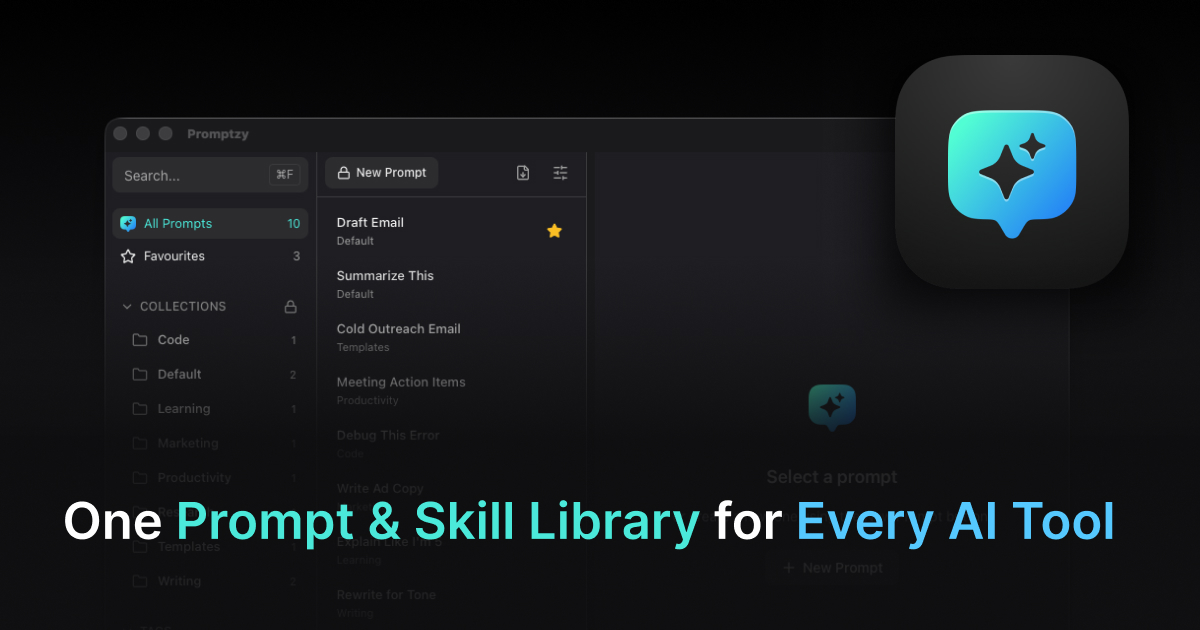
Store and manage your prompts with Promptzy
Free prompt manager for Mac. Search with Cmd+Shift+P, auto-paste into any AI app.
Download Free for macOS