
The 25 Best AI Prompts for Resumes and Cover Letters
Most resumes and cover letters fail the same way. Either they are generic to the point of being interchangeable with 500 other applications on the hiring manager's desk, or they are so stuffed with buzzwords that the actual work the person did has been buried under three layers of corporate English. AI is genuinely useful here, but only if you give it your real experience first and force it to cut, sharpen, and tailor instead of invent. A resume that reads like a ChatGPT default is worse than one with typos, because the typos at least suggest a human was trying.
Below are 25 prompts I use when I am helping someone with their job materials. Job descriptions, LinkedIn profiles, draft bullets, cover letter skeletons, and raw career histories all go into {{clipboard}}. Pick the four or five that match where you are in the process and save them somewhere you can fire in two seconds so you are not rewriting prompts for every application.
Jump to a section
Tailoring the resume to a specific job
1. Extract the real requirements from a job description
I am about to tailor my resume to a specific job. Before I start editing, I want to understand what the employer actually cares about, not just the laundry list in the job description.

Here is the full job description:

{{clipboard}}

Produce:

1. The three most important responsibilities, inferred from how much space and emphasis each gets.
2. The must have skills versus the nice to have skills, separated clearly.
3. Any phrasing that suggests the role is being newly created, backfilling someone, or restructured.
4. The success metric the hiring manager probably cares about in the first six months.
5. The personality or working style signals hidden in the description (collaborative, autonomous, fast paced, process oriented, etc.).
6. Any requirement in the description that is probably flexible, based on how it is phrased.

Do not pad the list. If something is genuinely less important, say so.
2. Compare my resume to a target job description
I have my current resume and the job description for a role I want to apply to. Help me see where I match, where I do not, and where I should focus my tailoring.

Here is both:

{{clipboard}}

Produce:

1. A table with three columns: requirement, how my resume currently addresses it, and a gap score from 0 to 3 (0 = fully addressed, 3 = completely missing).
2. The three strongest alignments I should highlight in my tailored version.
3. The three biggest gaps, and for each one, whether I have relevant experience that is hidden in my resume and could be surfaced.
4. Any resume bullet that is not relevant to this job and should be cut or rewritten.
5. A one paragraph summary of my positioning for this specific role: what angle I should take.

Do not invent experience I do not have. Only work from what is in my resume.
3. Reorder my resume to emphasize what matters for this role
I want to reorder the content in my resume so the most relevant experience for a specific role is the first thing a recruiter sees.

Here is my resume and the target job description:

{{clipboard}}

Produce:

1. A reordered outline of my resume sections, with a note on what moved where.
2. Within the work experience section, a note on which bullets to move up or down within each job.
3. Any job or project that I should promote from a secondary section (like "other experience") into a primary position.
4. Any section I should add, remove, or rename for this specific application.
5. A flag for any change that might feel dishonest (for example, demoting an actual primary role to fit a narrative) so I can decide whether to go that far.

Stay within the existing content. Reorder and re emphasize, do not fabricate.
Writing bullet points that show impact
4. Turn a task description into an impact bullet
I wrote a resume bullet that describes what I did, but not the impact. Rewrite it as a bullet that shows the result, not just the activity.

Here is the bullet and any context I have about the outcome:

{{clipboard}}

Produce:

1. Three rewrites, each emphasizing a different angle: business impact, team impact, or technical impact.
2. Each rewrite should start with a strong verb, not a throat clearing word like "responsible for" or "tasked with."
3. Each rewrite should include a number or a specific outcome if I gave you one. If I did not, leave a bracketed placeholder like [X percent].
4. None of the rewrites should use the words "leveraged," "utilized," "facilitated," "spearheaded," or "synergized."
5. Under 30 words each.
6. A note on which version is strongest and why.

If I did not give you enough outcome information to make any of them impact focused, tell me what to ask myself to surface it.
5. Quantify a bullet that has no numbers
I have a resume bullet that describes real work but has no numbers, and it reads as weak because of it. Help me find a way to quantify it honestly.

Here is the bullet and everything I remember about the work:

{{clipboard}}

Produce:

1. A list of possible metrics I could use to quantify the impact: time saved, errors reduced, users affected, revenue influenced, cost avoided, team size, frequency, size of dataset, number of releases.
2. For each metric, a question I should ask myself to estimate it if I do not remember the exact number.
3. A rewrite of the bullet with one quantifier added, using a placeholder for any number I need to verify.
4. A flag for any number that would be misleading if I claimed it (for example, team metrics that I did not personally drive).
5. A shorter, unquantified version of the bullet that is still strong in case I cannot verify any numbers.

Do not invent numbers. If I cannot justify a number, do not put one in.
6. Rewrite a vague bullet to be specific
I have a resume bullet that is too vague. It could describe work at any company in any role. Rewrite it to be specific enough that a reader understands what I actually did.

Here is the bullet and the context:

{{clipboard}}

Produce:

1. Three rewrites, each adding different specifics: the tool, the domain, the scale, the team structure, the business outcome.
2. Each should be under 30 words.
3. Each should read like it could only describe this particular job, not a generic version of it.
4. A note on which specifics are safe to include (publicly known, not NDA) and which might be sensitive.
5. The one I would use and why.

Avoid brand name dropping for its own sake. Specifics should add meaning, not name drop.
Summary and headline
7. Write a resume summary that is not generic
I need a resume summary (the three or four sentence block at the top). Every summary on the internet sounds the same. I want one that is specific to me and to the roles I am targeting.

Here is my background, my target role, and any positioning I want to lead with:

{{clipboard}}

Produce:

1. Three versions of the summary, each taking a different angle: experience first, impact first, or narrative first.
2. Each version is three to four sentences, under 60 words total.
3. None of them use "results driven," "passionate," "proven track record," "highly motivated," or "seasoned."
4. Each version names a specific domain, stack, or function rather than abstractions.
5. A note on which version fits a recruiter's first read the best, and which fits a hiring manager's first read.
6. A flag for any version that sounds like something hundreds of other candidates would also write.

Keep it grounded in what I actually did.
8. Write a LinkedIn headline that stands out
I need a LinkedIn headline. Not the default "Senior X at Y." I want something that gives a recruiter a reason to click on my profile.

Here is my role, background, and target audience:

{{clipboard}}

Produce:

1. Five headline options, each under 220 characters.
2. Each should include a specific claim, specialty, or angle that differentiates me from people with the same title.
3. Variety across the five: one that leads with role, one with outcomes, one with specialty, one with industry, one with a contrarian or memorable framing.
4. None should use emojis unless I told you the target audience appreciates them.
5. A ranking of the five based on how likely they are to lead to profile clicks from the people I want to reach.

Avoid fake humility ("trying to make the internet better"). Avoid corporate buzzwords.
9. Write a short elevator pitch for my career
I need a 30 second elevator pitch about my career that I can use in interviews, networking, and the "tell me about yourself" question.

Here is my career, highlights, and where I want to go next:

{{clipboard}}

Produce:

1. A pitch between 60 and 90 words.
2. Structured as: one sentence about who I am professionally, two sentences about the most relevant highlights, one sentence about what I am looking for next.
3. Conversational, not a resume read aloud.
4. Contains at least one specific number or concrete detail.
5. Does not use the word "passionate" or "journey."
6. A shorter 30 word version for situations where I have less time.

After the pitch, tell me which sentence to emphasize if a recruiter interrupts and asks "tell me more about that."
Cover letter openers
10. Write a cover letter opener that is not "I am writing to apply"
I need a first paragraph for a cover letter. Every cover letter on the internet starts with "I am writing to apply for the X position." I want to start differently without being weird or gimmicky.

Here is the role, company, and one thing that actually drew me to the job:

{{clipboard}}

Produce:

1. Five opening paragraphs, each taking a different angle: a personal connection, a specific observation about the company, a moment from my experience that mirrors the role, a thoughtful question, or a direct statement of fit.
2. Each under 80 words.
3. None should start with "I," "My name is," or "I am writing."
4. Each should lead to the next paragraph naturally.
5. A note on which opener works best for a senior role versus an early career role.

Do not be cute. Do not try to be memorable at the expense of being professional.
11. Open a cover letter with a story
I want to open a cover letter with a short story or anecdote that sets up why I am the right person for this role. Not a life story. A moment.

Here is the role and the anecdote I want to use (or what kind of story I want to tell):

{{clipboard}}

Produce:

1. Three openings, each a different moment framed slightly differently: a problem I solved, a decision I made, or a conversation that changed how I work.
2. Each under 100 words.
3. Each should connect naturally to the role's requirements without being heavy handed about the connection.
4. None should use "I have always wanted to" or "ever since I was young."
5. The details should feel specific and real, not like a TED talk opener.

Tell me which opening best sets up the rest of a cover letter for this role.
12. Reference something about the company without being generic
I want to reference something specific about the company in my cover letter that shows I did more than look at the homepage. Help me turn raw research into a natural sentence.

Here is what I found about the company and the role:

{{clipboard}}

Produce:

1. Three sentences I could work into a cover letter, each referencing a different piece of research: a product choice, a public statement, a recent announcement, a team member's published work, or a company value.
2. Each should sound like an observation, not a compliment.
3. None should be flattering to the point of sycophancy.
4. Each should lead naturally into a sentence about why I care.
5. A flag for any sentence that would come across as pandering or superficial.

Do not invent anything about the company that is not in the material I gave you.
Full cover letter drafts
13. Draft a full cover letter from my resume and the job description
I need a full cover letter draft. Not a template with slots filled in. Something that sounds like a specific person writing to a specific company for a specific role.

Here is my resume and the job description:

{{clipboard}}

Write a cover letter with:

1. An opener that is not "I am writing to apply."
2. A second paragraph connecting my experience to the top two requirements in the job description, with one specific example that proves it.
3. A third paragraph showing genuine interest in the company or team, grounded in something specific.
4. A short closing that suggests a concrete next step without being pushy.
5. Total length between 250 and 350 words.
6. No em dashes. No en dashes. No "I am passionate about." No "I believe I would be a great fit."

Voice: warm, direct, confident without being arrogant. Read it back and tell me whether it sounds like me or like a template. If it sounds like a template, start over.
14. Write a cover letter for a role I am stretching into
I am applying for a role that is a stretch: adjacent experience, related skills, but not a direct match. I need a cover letter that addresses the gap honestly without undermining my candidacy.

Here is my background, the role, and the gap:

{{clipboard}}

Write a cover letter that:

1. Opens with the strongest overlap I have with the role, not the gap.
2. Names the gap explicitly, early, in a way that defuses the objection rather than avoiding it.
3. Presents my adjacent experience as a feature, not a consolation prize, with a specific example.
4. Demonstrates that I have done the work to understand what the new role actually requires.
5. Ends with curiosity and openness, inviting the hiring manager to explore the fit in conversation.
6. Under 350 words.

Do not be apologetic. Do not undersell. But also do not pretend the gap is not there.
15. Rewrite a cover letter to sound less stiff
My cover letter draft sounds corporate and stiff. I want to rewrite it to sound like me without making it too casual for a professional context.

Here is the current draft:

{{clipboard}}

Produce:

1. A rewrite that preserves all the substantive content but loosens the voice: shorter sentences, contractions where natural, plain language instead of corporate speak.
2. A list of specific phrases from the original that I should never use in a cover letter, with explanations.
3. The one sentence in the rewrite where I most sound like a human, and why.
4. A second, even less formal version in case the company culture is casual.
5. No em dashes. No en dashes.

After the rewrites, tell me which version fits the company's voice better based on what I told you about the company.
Gaps, changes, and weak spots
16. Explain a resume gap in a cover letter
I have a gap in my resume (time off, sabbatical, caretaking, layoff, health, or personal reasons) and I want to address it in my cover letter without overexplaining or apologizing.

Here is the situation and the context about the gap:

{{clipboard}}

Produce:

1. Two or three sentences I could include in the cover letter that acknowledge the gap without dwelling on it.
2. A version for a gap I want to explain in detail and a version for a gap I would rather keep private.
3. A framing of the gap as part of my story, not a deficit to overcome.
4. Any phrase I should avoid because it sounds defensive ("I was laid off due to no fault of my own").
5. A note on whether it is better to address the gap in the cover letter at all, versus letting it come up in the interview.

Be realistic. If the gap is a dealbreaker for some employers, do not pretend otherwise.
17. Reframe a career change in a cover letter
I am changing careers and I need to reframe my previous experience as relevant to the new role. Not dishonestly, but in a way that surfaces the transferable parts.

Here is my background and the target role:

{{clipboard}}

Produce:

1. The three strongest transferable skills from my previous career that map to this new role, stated in the language of the new field.
2. A paragraph for the cover letter that bridges the career change without making it sound like a cliche transition story.
3. One concrete example from my past work that would be impressive to someone in the new field, even if they do not understand the domain I came from.
4. A sentence that explains why I am making the change, in a way that is forward looking and not bitter about the past.
5. A note on the one specific question a hiring manager will ask about my change that I need to be ready for.

Do not pretend my old career was secretly this new career all along. Be honest about the change.
Keywords and ATS optimization
18. Identify the keywords in a job description I should include
I want my resume to make it past ATS filters and into a human reader's hands. Help me identify the keywords in this job description that I should include naturally in my resume.

Here is the job description:

{{clipboard}}

Produce:

1. A list of exact keyword phrases from the description that a recruiter or ATS might search for.
2. A priority ranking: must include, should include, nice to include.
3. For each high priority keyword, a suggestion for where in my resume it could fit naturally (summary, skills section, specific bullet).
4. Any keyword that appears multiple times in the description (signaling importance).
5. A flag for any buzzword that ATS does not care about but that readers might, and vice versa.
6. A warning about any keyword I should NOT include because it would be dishonest given my experience.

Do not suggest keyword stuffing. Natural inclusion only.
19. Check my resume against ATS requirements
I want you to audit my resume for ATS compatibility before I submit it.

Here is my resume (ideally pasted as text, not as an image):

{{clipboard}}

Check for:

1. Standard section headings that ATS can recognize (Experience, Education, Skills, etc.).
2. Fancy formatting that can break parsing: tables, columns, text in images, headers and footers, fancy bullet characters.
3. Dates formatted consistently.
4. Contact information in a location ATS expects.
5. File format recommendations: PDF vs Word.
6. Any phrase or structure that typically confuses ATS.
7. Whether the skills section is discoverable by keyword search.

For each issue, give severity and a concrete fix. Do not strip all formatting to the point of making the resume ugly for humans. Balance.
20. Rewrite a resume bullet to include a keyword naturally
I need to include a specific keyword in my resume, but the bullet where it fits is already written. Rewrite it to include the keyword without making it awkward.

Here is the current bullet, the keyword, and any context:

{{clipboard}}

Produce:

1. Two rewrites, each integrating the keyword in a different way.
2. Each version should still read as natural English, not a keyword pasted into a sentence.
3. Each should preserve the original meaning and impact.
4. Under 30 words.
5. A note on whether the keyword could fit better somewhere else in the resume, like the skills section or summary, instead of this bullet.

If forcing the keyword here would damage the bullet, tell me so and recommend a different location.
Formatting and cleanup
21. Audit my resume for clarity and polish
Do a final pass on my resume for clarity, consistency, and small mistakes.

Here is my resume:

{{clipboard}}

Check:

1. Consistency of verb tense across bullets (past tense for past roles, present for current).
2. Consistency of punctuation at the end of bullets (all have periods or none do).
3. Bullet length: too long, too short, wildly inconsistent.
4. Repetition of the same opening verb across bullets.
5. Clarity of job titles, especially if they are internal jargon.
6. Clarity of company descriptions if the company is not well known.
7. Dates: consistent format, no overlaps or gaps without context.
8. Any typos, grammar errors, or odd word choices.

Flag each issue with line location and a concrete fix. Do not rewrite the whole resume.
22. Tighten verbose bullets without losing meaning
My resume bullets are too long and I need to tighten them. Help me cut words without losing the meaning.

Here are the bullets:

{{clipboard}}

For each bullet, produce:

1. A tightened version under 25 words.
2. A count of how many words you removed.
3. The specific phrases that were padding (filler adjectives, unnecessary articles, wordy constructions).
4. A flag if any meaning was genuinely lost in the tightening.
5. A version even tighter (under 18 words) as an option for space constrained templates.

Do not tighten to the point of being unclear. A short bullet is only better if a reader still understands what I did.
Follow up emails after applying
23. Write a follow up email after submitting an application
I submitted an application and I want to send a brief follow up email to the hiring manager or recruiter.

Here is the role, my name, and any context I have about the hiring process:

{{clipboard}}

Produce:

1. A follow up email under 90 words.
2. Not a "just checking in" email. Adds one specific thing: a relevant piece of news, a question about the process, or a short example of my work.
3. Subject line under 45 characters.
4. Opens with something other than "I hope this finds you well."
5. Ends with a clear, small next step or question.
6. Tells the reader the stage I am at (applied, had a screen, had an interview) so they know how to respond.

If I have a LinkedIn connection or a referral, integrate that naturally in the body.
24. Write a thank you note after an interview
I just had an interview and I want to send a thank you note. Not a formulaic one. A real one.

Here is the interview: who I met with, what we talked about, and my honest impression:

{{clipboard}}

Produce:

1. A thank you email under 120 words.
2. References a specific moment from the conversation, not just "thank you for your time."
3. Reinforces one specific thing I said during the interview that I want to stay memorable.
4. Addresses any question I did not answer as well as I wanted to, if applicable, in one clean sentence.
5. Ends with forward looking language, not pleading or grovelling.
6. Subject line under 40 characters.

Do not be sycophantic. Do not pretend the interview was transformative. Just be warm and specific.
25. Write a withdrawal email that keeps the relationship intact
I need to withdraw from a hiring process, either because I accepted another offer or because I realized the role is not right. I want to do it in a way that leaves a good impression for the future.

Here is the context:

{{clipboard}}

Produce:

1. A withdrawal email under 100 words.
2. Clear and direct about the withdrawal in the first sentence.
3. Brief reason that is honest but not overly detailed.
4. Genuine thanks for their time and consideration.
5. A note that leaves the door open for future conversations, without sounding like I am angling for it.
6. No apologies beyond a simple acknowledgment.

If I accepted another offer, I do not need to name the other company. Keep it professional and forward looking.
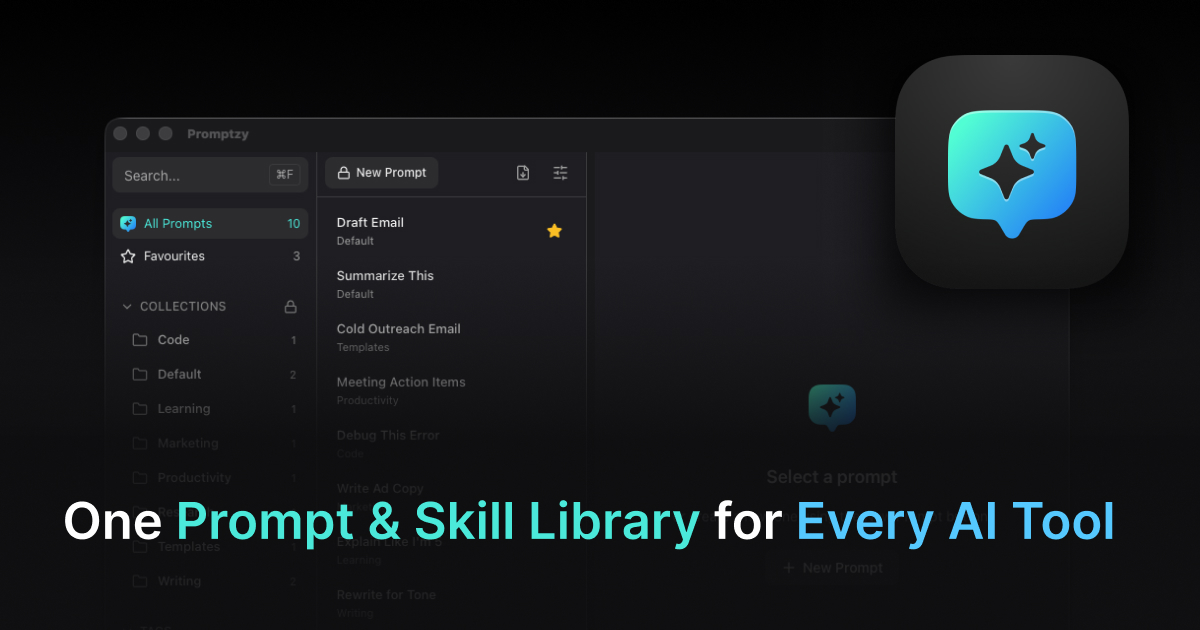
Store and manage your prompts with Promptzy
Free prompt manager for Mac. Search with Cmd+Shift+P, auto-paste into any AI app.
Download Free for macOS