
The 40 Best ChatGPT Prompts for Marketers (With Templates)
The difference between generic AI output and actually useful marketing copy is almost always the prompt. "Write me an email" gets you something forgettable. A specific, well-structured prompt gets you a draft worth editing.
These 40 prompts are the result of real marketing work — ad campaigns, email sequences, landing pages, SEO briefs. Each one is specific enough to produce something usable and structured to be reused as a template. If you're tired of rewriting the same campaign briefs, save your top-performing marketing prompts once and reuse them forever. Where you need to insert your own context, I've marked it with {{clipboard}} or [brackets].
Ad Copy
1. Google Search ad
Write 5 Google Search ad variations for {{clipboard}}.

For each: headline 1 (30 chars max), headline 2 (30 chars max), headline 3 (30 chars max), description 1 (90 chars max), description 2 (90 chars max).

Focus on: [main benefit], [key differentiator]. Include a clear CTA. Avoid superlatives like "best" or "#1" unless I confirm I can use them.
2. Meta/Facebook ad
Write 3 Facebook/Instagram ad variations for {{clipboard}}.

For each provide: Primary text (125 chars), Headline (40 chars), Description (30 chars).

Audience: [describe target audience]. Objective: [awareness/clicks/conversions]. Tone: [professional/casual/urgent].
3. LinkedIn ad
Write a LinkedIn Sponsored Content ad for {{clipboard}}.

Include: Introductory text (150 chars), Headline (70 chars), Description (100 chars).

Audience: [job title/seniority/industry]. Value prop: [what problem does this solve for them?]. Tone: professional but human — not corporate.
4. Ad hooks (5 variants)
Write 5 opening hooks for an ad about {{clipboard}}.

Each hook should be under 15 words and use a different approach: question, bold claim, pain point, curiosity, and social proof. I'll pick the strongest to develop further.
5. Retargeting ad
Write a retargeting ad for people who visited our site but didn't convert. Product: {{clipboard}}.

Address likely objections. Reinforce the value. Include a low-friction CTA. Tone: friendly, not pushy.
Landing Pages & Conversion Copy
6. Hero section copy
Write hero section copy for a landing page: {{clipboard}}.

Include: H1 headline (under 10 words), subheadline (1-2 sentences), and 3 bullet points of key benefits. The headline should communicate the core value prop immediately — no clever wordplay that obscures meaning.
7. Feature section copy
Write copy for a features section of a landing page. Product: {{clipboard}}.

For each of these 3 features: [feature 1], [feature 2], [feature 3].

Format: Feature name, one-line benefit statement, 2-3 sentence explanation focused on outcome for the user (not technical specs).
8. FAQ section
Write 8 FAQ questions and answers for this product: {{clipboard}}.

Focus on: real objections buyers have, pricing/value questions, "how does it compare to X", and anything that might prevent someone from buying. Be honest and specific.
9. CTA section
Write 5 CTA variations for: {{clipboard}}.

Each should have: headline, subtext (1 sentence), and button copy. Vary the angle — try urgency, benefit, curiosity, social proof, and risk reversal.
10. About Us page
Write an About Us page for: {{clipboard}}.

Cover: why the company was started (founder story angle), what makes it different, who it's for. Tone: human and honest — not a press release. 200-300 words.
Email Marketing
11. Welcome email
Write a welcome email for new subscribers/users of {{clipboard}}.

Cover: what they can expect, one immediate action they should take, and a personal note from the founder. Under 200 words. No fluff.
12. Product announcement email
Write a product announcement email for: {{clipboard}}.

Structure: compelling subject line, 1-sentence hook, what's new and why it matters, who benefits from it, clear CTA. Tone: excited but not hypey.
13. Re-engagement email
Write a re-engagement email for users who haven't logged in for 30+ days. Product: {{clipboard}}.

Acknowledge the silence briefly, remind them of the core value, offer something (tip, new feature, etc.), and make it easy to come back. Under 150 words.
14. Cold outreach email
Write a cold outreach email to {{clipboard}}.

Purpose: [what you want]. Keep it under 100 words. Lead with something specific about them (not a generic compliment), make one clear ask, and include a single easy CTA. No corporate-speak.
15. Abandoned cart/signup email
Write an abandoned [cart/signup] email for {{clipboard}}.

User got to [step] but didn't complete. Address the likely friction point, reassure them, and make completing easy. Subject line should acknowledge why they might have paused.
16. Email subject line variants
Write 10 subject line variations for an email about: {{clipboard}}.

Include: 2 curiosity-driven, 2 benefit-driven, 2 question-based, 2 personalised ([First Name] format), 1 provocative, 1 direct. Mark which you'd A/B test.
SEO & Content
17. SEO content brief
Write an SEO content brief for: target keyword "{{clipboard}}".

Include: article angle/title, target audience, search intent, H2 structure (5-7 sections), key points to cover in each section, and 3-5 semantically related terms to include naturally.
18. Meta title and description
Write 3 meta title and description variants for a page about: {{clipboard}}.

Title: under 60 chars. Description: under 155 chars. Include the primary keyword naturally. Make the description compelling enough to improve CTR — not just a summary.
19. Blog post intro
Write 3 different opening paragraphs for a blog post about: {{clipboard}}.

Try these angles: (1) open with a relatable problem, (2) open with a surprising stat or claim, (3) open with a story. Each should hook the reader and set up the article clearly.
20. Content repurposing
Take this long-form content and repurpose it into: (1) a Twitter/X thread of 5 tweets, (2) a LinkedIn post, (3) 3 Instagram caption options.

Content: {{clipboard}}
Social Media
For a deeper set of prompts focused specifically on professional social content, see our LinkedIn post prompts guide.
21. LinkedIn post
Write a LinkedIn post about: {{clipboard}}.

Format: hook in first line (creates curiosity or states something bold), 3-5 short paragraphs or bullet points, personal takeaway or question at the end. Avoid hashtag overload (max 3). No corporate buzzwords.
22. Twitter/X thread
Write a 6-tweet thread about: {{clipboard}}.

Tweet 1: bold hook that makes people want to read on. Tweets 2-5: one key point each, specific and actionable. Tweet 6: summary + CTA. Keep each tweet under 250 chars.
23. Instagram caption
Write an Instagram caption for a post about: {{clipboard}}.

First line: attention-grabbing hook (visible before "more"). Body: expand on the hook with 3-4 short paragraphs. End with a question or CTA. 3-5 relevant hashtags.
24. Social proof post
Turn this customer testimonial into a social media post: {{clipboard}}.

Make it feel genuine, not like a sales ad. Lead with the customer's result or experience, not the product name.
Strategy & Analysis
25. Competitor analysis
Analyse the marketing of this competitor: {{clipboard}}.

Cover: their positioning, messaging angles, key CTAs, apparent target audience, what they do well, and gaps I could exploit. Be specific — look at their headlines, not just their general approach.
26. SWOT analysis
Write a SWOT analysis for: {{clipboard}}.

Be specific and honest — especially about weaknesses and threats. Don't give generic answers. Each point should be actionable.
27. Positioning statement
Write 3 positioning statement options for: {{clipboard}}.

Format: "For [target audience] who [need/want], [product] is the [category] that [key benefit], unlike [alternative] which [limitation]."

Make each positioning statement distinct — different audiences, different angles.
You can templatize campaigns with variables for product, audience, and channel so a single prompt adapts to every launch.
28. Campaign naming
Generate 10 campaign name ideas for: {{clipboard}}.

Mix: aspirational names, problem-focused names, benefit-focused names, and memorable/unexpected names. Short (2-4 words) and easy to say out loud.
29. Pricing page copy
Write copy for a three-tier pricing page: {{clipboard}}.

For each tier: name, tagline, 5 key features/benefits, and who it's for. Make the middle tier feel like the obvious choice. Avoid "Enterprise" as a name unless it's truly enterprise.
30. Launch announcement
Write a product launch announcement for: {{clipboard}}.

Versions needed: (1) email to existing users/subscribers, (2) press release opening paragraph, (3) social media post. Each should feel appropriate for its channel.
Research & Brainstorming
31. Audience research questions
Generate 15 survey or interview questions to understand why people buy/use {{clipboard}}.

Include: questions about the problem before they found us, why they chose us over alternatives, what almost stopped them buying, and what they wish we'd improve.
32. Headline brainstorm
Generate 20 headline ideas for {{clipboard}}.

Use different formulas: How-to, numbered list, question, "X for Y", benefit-first, curiosity-gap, and bold claim. I'll select the strongest 3 to test.
33. Value proposition variants
Write 5 different value proposition statements for {{clipboard}}.

Each should answer "why buy this instead of the alternative?" from a different angle: speed, price, quality, simplicity, trust. Under 15 words each.
34. Content ideas
Generate 20 content ideas (blog posts, videos, or social posts) for a company that sells {{clipboard}}.

Focus on topics their target audience actively searches for — not just product marketing. Group by: educational, comparison, use case, and thought leadership.
If your marketing feeds directly into pipeline, our sales prompts for lead generation cover the outreach side of demand gen.
35. Objection handling
List the 10 most common objections a prospect might have about buying {{clipboard}}.

For each objection: restate it honestly, then write a response that addresses it without being defensive. Be specific — not "great question, we hear that a lot."
Copywriting Frameworks
36. PAS framework
Write copy using the Problem-Agitate-Solution framework for {{clipboard}}.

Problem: clearly state the pain. Agitate: make them feel it — consequences, frustration, cost of inaction. Solution: introduce the product as the fix. 150-200 words.
37. AIDA framework
Write copy using the AIDA framework for {{clipboard}}.

Attention: hook. Interest: keep them reading with relevant info. Desire: make them want it. Action: clear CTA. Adapt the length to the channel: [email/landing page/social post].
38. Before/after/bridge
Write copy using the Before/After/Bridge framework for {{clipboard}}.

Before: describe their current painful situation. After: paint the picture of life with the solution. Bridge: explain how this product gets them there.
39. Features vs benefits rewrite
Rewrite these product features as customer benefits: {{clipboard}}.

For each feature, ask "so what?" and answer it from the customer's perspective. Focus on outcomes and emotions, not specs.
40. Tone rewrite
Rewrite this copy in a [more casual/more professional/more urgent/more empathetic] tone: {{clipboard}}.

Keep the same key messages and structure but change the voice significantly. Show me the contrast clearly.
Keep These Prompts Handy
Forty prompts is a lot to hold in your head. The ones you use daily are worth binding to a keyboard shortcut so you can fire them in one keystroke. If you want to organize your marketing prompts, we've compared the best tools for that.
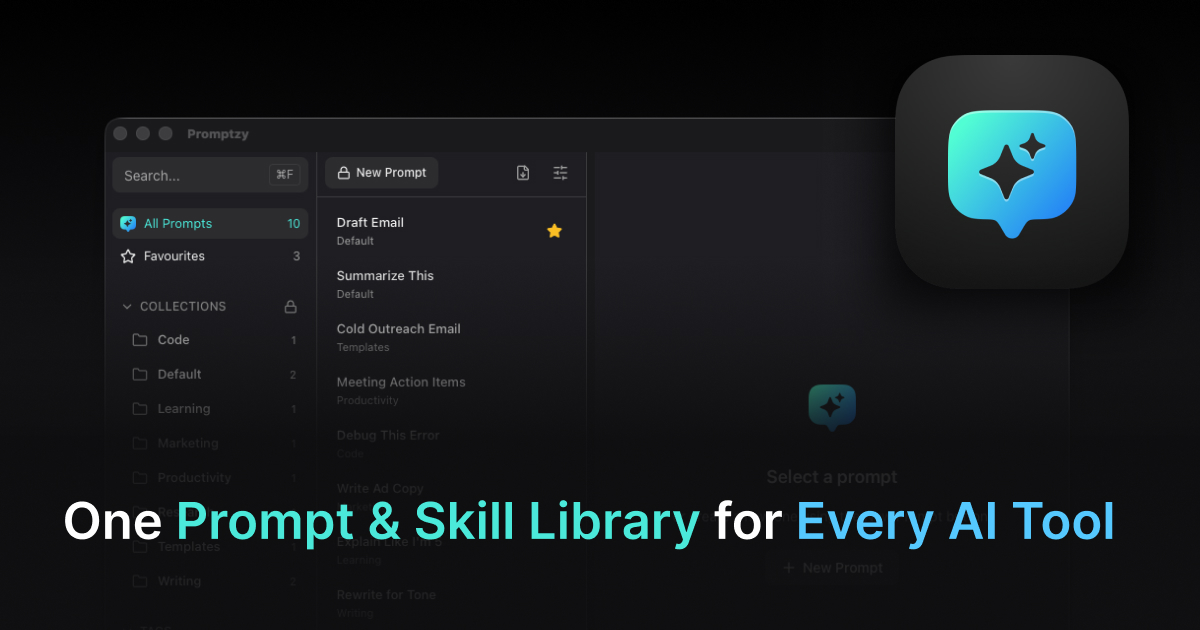
Promptzy stores prompts as plain Markdown files and lets you search and paste them anywhere on your Mac with Cmd+Shift+P. It includes a free built-in Markdown editor, so you can draft and refine copy without switching to another app. Assign per-prompt shortcuts to your top 5 and you'll never have to find them again.
promptzy.app — free tier available, $5 one-time Pro.
Store and manage your prompts with Promptzy
Free prompt manager for Mac. Search with Cmd+Shift+P, auto-paste into any AI app.
Download Free for macOS