
The 35 Best ChatGPT Prompts for Sales and Business Development
If you're in sales, AI is either your biggest unfair advantage or someone else's. The reps who figure out how to use it well — writing tighter outreach, prepping for calls faster, handling objections more confidently — are pulling ahead fast. The ones still manually drafting the same cold email for the 40th time are getting left behind.
This isn't a list of generic prompts you'll use once and forget. These are prompts built around the actual stages of a sales cycle: prospecting, outreach, discovery, proposals, follow-up, and closing. Copy them, adapt them to your product, and stop rewriting your cold outreach prompts every time you sit down to prospect.
Cold Outreach
Cold email is still one of the highest-leverage activities in B2B sales. The problem is that most reps use AI to write the same bland email everyone else is sending. These prompts are designed to produce something a real person would actually read. You can make them even more powerful by adding variables for prospect name, company, and pain point so one template covers every outreach scenario.
1. Personalized cold email from LinkedIn research
Write a cold outreach email based on the following research about the prospect. Keep it under 120 words. Focus on one specific insight, not a list of observations. End with a low-friction CTA (a question, not a meeting request).

Prospect info: {{clipboard}}
My product: Promptzy — a macOS app that stores and pastes AI prompts in 2 seconds via Cmd+Shift+P.
My company/role: [your name, company]
2. Pattern interrupt opener
Write 5 different opening lines for a cold email to a [job title] at a [company type] company. Each opener should feel like something a real person wrote — not a template. Avoid starting with "I", compliments about their company, or questions about their "biggest challenges." Make each one distinct: one curiosity-based, one insight-based, one observation-based, one contrarian, one ultra-short.
3. Cold LinkedIn DM (under 50 words)
Write a LinkedIn DM to a [job title] about [topic]. Max 50 words. No compliments, no "I hope this message finds you well." Start with a direct observation or insight. End with a yes/no question.
4. Cold email sequence (3 emails)
Write a 3-email cold outreach sequence for the following prospect and offer. Email 1: value-led opener (under 120 words). Email 2: follow-up that provides one useful insight or resource, doesn't re-pitch (3-4 days later). Email 3: short break-up email that's honest and leaves the door open. Prospect context: {{clipboard}}
5. Re-engagement email (gone cold)
Write a short re-engagement email for a prospect who went silent 3 weeks ago after initial interest. Don't be passive-aggressive. Acknowledge the silence briefly, provide one new piece of value (a case study, a relevant insight, or a new feature), and end with a low-effort ask.

Original context: {{clipboard}}
Discovery Calls
The best discovery calls feel like good conversations, not interrogations. These prompts help you prep, not just wing it.
6. Discovery call prep from LinkedIn + company website
I'm about to do a discovery call with the following prospect. Based on this context, give me: 3 tailored discovery questions I should ask, 1 likely objection and how to address it, and 2 things I should research before the call.

Prospect context: {{clipboard}}
7. Generate discovery questions by pain
Generate 10 open-ended discovery questions for a [job title] who likely has the following pain points: [list 2-3 pain points]. Questions should uncover urgency, impact, and whether they've tried to solve this before. Avoid yes/no questions.
8. Pre-call research brief
Write a 1-page pre-call brief for a discovery call with [company name]. Include: company overview, recent news, their likely priorities based on their industry and size, 3 hypothesis-based questions I can test on the call, and potential competitors or tools they're probably using.
9. MEDIC/BANT qualification questions
Write 8 qualification questions I can weave naturally into a discovery conversation to assess: budget, authority, need, timeline, and whether they have an existing solution they'd be replacing. Questions should sound conversational, not like a checklist.
10. Call debrief and next steps summary
Based on these discovery call notes, write: a 3-bullet summary of what I learned, the prospect's top stated pain, the agreed next steps, and any red flags or deal risks I should track.

Call notes: {{clipboard}}
Objection Handling
Objections are requests for more information. These prompts help you think through responses in advance so you're not fumbling in the moment.
11. Handle "we're happy with what we have"
Write 3 different responses to the objection "we're happy with our current solution." Each response should: acknowledge the objection genuinely (not dismissively), probe for the real cost of staying put, and pivot to a specific differentiator. Product context: {{clipboard}}
12. Handle "it's too expensive"
Write a response to "your pricing is too high" that doesn't immediately offer a discount. Instead, reframe the conversation around ROI, cost of inaction, and what "too expensive" usually means in terms of the budget holder's real concern. Product: {{clipboard}}
13. Handle "send me more info"
Write a response to "just send me more info" that keeps the deal moving. Acknowledge the request, ask one clarifying question to make the follow-up more targeted, and set a specific follow-up moment (not "I'll send it over and follow up in a few days").
14. Handle "not the right time"
Write 3 responses to "we're not ready to look at this right now." One should explore what "right time" actually means, one should offer a future-paced small step (like a 10-minute call in 3 months), one should leave the door open gracefully and make a lasting impression.
15. Build an objection handling cheat sheet
Based on my product below, generate the 8 most common sales objections I'll likely face, with a 2-3 sentence response for each. Responses should be honest and consultative — not salesy or dismissive.

Product: {{clipboard}}
Proposals and Follow-Ups
Getting to a proposal is the easy part. Writing one that actually closes is where most reps lose deals.
16. Executive summary for a proposal
Write a 150-word executive summary for a sales proposal. The audience is a CFO or VP-level decision maker. Lead with their stated pain, show the cost of inaction, describe the solution in 1-2 sentences, and end with a clear outcome they can expect.

Context: {{clipboard}}
17. ROI justification section
Write an ROI section for a sales proposal. Use conservative numbers. Show the math clearly. Frame it as time saved per week × hourly rate, not vague "increased productivity" claims. Include a payback period estimate.

Product details and customer context: {{clipboard}}
18. Follow-up after sending a proposal
Write a follow-up email to a prospect who received my proposal 3 days ago and hasn't responded. Don't just ask "did you get a chance to look at it?" Instead, provide one specific piece of value (a customer story, a relevant use case, or a new insight) and ask a direct question that moves the deal forward.
If you're looking to sharpen the writing itself beyond sales-specific templates, our email writing prompts guide covers structure, tone, and clarity for any kind of business email.
19. Post-demo follow-up email
Write a follow-up email after a product demo. Recap the top 2 things that resonated most (based on context below), address the one concern raised, include the agreed next step, and attach social proof relevant to their situation.

Demo notes: {{clipboard}}
20. Deal stall follow-up (internal champion)
Write an email to my internal champion at a prospect who seems stuck — they liked the product but haven't been able to get sign-off. Help me understand where things stand internally, offer to help remove blockers (like a CFO one-pager or an exec-level call), and keep the tone collaborative rather than pushy.
LinkedIn and Social Selling
21. LinkedIn connection request message
Write a LinkedIn connection request to a [job title] at [company type]. Max 3 sentences. Don't mention my product. Lead with a genuine reason to connect — shared context, a piece of their content I found useful, or a specific observation about their work.
22. Commenting on a prospect's LinkedIn post
Write a thoughtful LinkedIn comment on the following post from a prospect I want to build a relationship with. Don't be sycophantic. Add a specific perspective, counter-point, or relevant experience. Max 3 sentences.

Post text: {{clipboard}}
23. LinkedIn warm outreach after engagement
Write a LinkedIn DM to someone who engaged with my content (liked or commented). Acknowledge their engagement briefly, provide one related insight, and suggest a low-friction next step (not a full demo ask).
Deal Reviews and Pipeline Management
24. Win/loss analysis from a lost deal
Based on the following notes from a deal I just lost, write a structured win/loss analysis: why we likely lost (real reasons, not polite ones), what we could have done differently at each stage, and what I should do differently on the next similar deal.

Deal notes: {{clipboard}}
25. Deal risk assessment
Based on these deal notes, assess the top 3 risks to this deal closing this quarter. For each risk, suggest one specific action I can take this week to reduce it.

Deal notes: {{clipboard}}
26. Competitive positioning note
I'm going up against [competitor name] in a deal. Based on what I know about both products, write a one-page competitive battle card: where we win, where we're weaker, how to reframe the comparison, and the 3 questions I should ask to shift the evaluation criteria in our favor.

Our product: {{clipboard}}
27. Account expansion email to existing customer
Write an expansion email to an existing customer who's been using our product for 6 months. The goal is to introduce them to a new feature or tier they haven't tried. Don't make it feel like upsell. Lead with what they've accomplished, show the next level of value they're leaving on the table.

Customer context and expansion opportunity: {{clipboard}}
Meeting and Communication
28. Meeting recap email
Based on these meeting notes, write a clear recap email: 3 bullet points of what was discussed, decisions made, action items with owners and dates, and next meeting time if agreed. Keep it under 150 words.

Notes: {{clipboard}}
29. Stakeholder alignment email
Write an internal email to [recipient role] summarizing the status of deal with [company]. Cover: where we are in the cycle, the key stakeholders and their positions, the top risk, and what we need from this person to move the deal forward.
30. Reference request email
Write an email asking a happy customer if they'd be willing to be a reference for a new prospect. Keep it short and specific — tell them who the prospect is, what industry they're in, and what the prospect's main concern is that this reference could address.
Business Development Specific
31. Partnership outreach email
Write a business development outreach email to propose a partnership with [company type]. Focus on mutual benefit, not just what we want. Identify 2-3 specific ways the partnership helps them first, and 1 low-commitment way to start (a call, a co-marketing idea, a pilot).
32. Event follow-up (met at a conference)
Write a follow-up email to someone I briefly met at [event name]. We talked about [topic]. Make it feel like a continuation of the conversation, not a sales pitch. Reference the specific thing we discussed and suggest one concrete next step.

Context from the conversation: {{clipboard}}
If you're also running lead gen campaigns alongside outbound, check out our ChatGPT prompts for marketers for demand gen and content-driven pipeline prompts.
33. Target account research brief
Write a 1-page account research brief for [company name] as a prospective customer. Include: company overview, likely business priorities, recent news or announcements, key stakeholders to target, likely pain points our product addresses, and the best entry point into the account.
34. Annual outreach plan for a key account
Create a 12-month touchpoint plan for a key account I'm trying to develop. Mix sales touches with value-based touches (sharing relevant content, congratulating on milestones, making introductions). No more than 1 sales-specific touch per month.

Account context: {{clipboard}}
35. Cold call opening script
Write a cold call opening for a [job title] at a [company type] company. Max 3 sentences. Get to the point immediately, mention one specific reason for calling that's relevant to them (not a generic pitch), and end with a question that invites them to talk — not a yes/no close.
A Word on Prompt Storage
The reps getting the most out of these prompts aren't pasting them from a doc every time. They're storing them in a system with a keyboard shortcut — so the moment they need a cold email opener or a post-demo follow-up, it's there in two seconds.
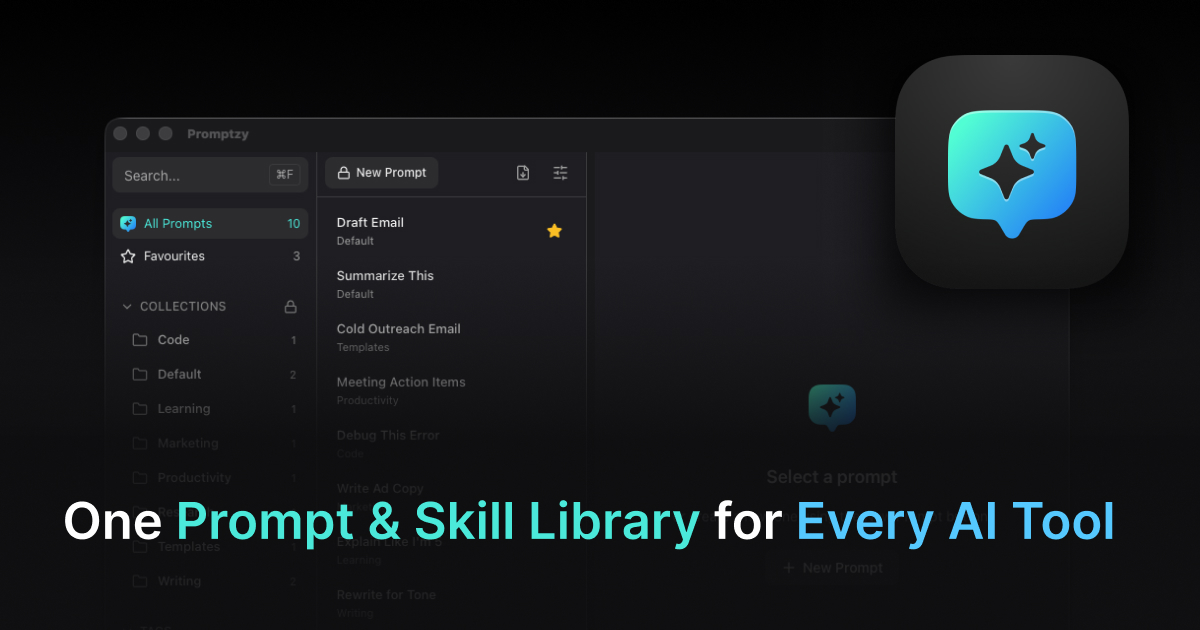
If you're on a Mac, Promptzy was built exactly for this. Manage your sales prompt playbook with a keyboard shortcut — store your whole library, search by name, hit Enter, and it pastes into whatever you're working in. The {{clipboard}} token automatically injects your clipboard content — paste in a prospect's LinkedIn bio, fire the outreach prompt, done.
Free for the first 10 prompts. Pro is $5 once.
Store and manage your prompts with Promptzy
Free prompt manager for Mac. Search with Cmd+Shift+P, auto-paste into any AI app.
Download Free for macOS