
The Best Perplexity AI Prompts for Research and Deep Dives (2026)
Perplexity is not a replacement for ChatGPT or Claude — it's a different tool. Its edge is real-time search with citations, which makes it excellent for research tasks where you need sourced, current information. Generic AI prompts don't take advantage of that. The prompts below are written specifically for what Perplexity does differently: surfacing cited answers, synthesising across sources, and handling questions where currency matters.
Use these for research tasks. For longer reasoning, writing, or coding, you'll likely get better results from a model with a longer context window. If you find research prompts you keep reusing, you can save your best research prompts so they're ready whenever you need them.
Market Research
These are where Perplexity pulls away from offline models. You get sourced, current answers that you'd otherwise spend an hour assembling manually.
1. Market overview
Give me a current overview of the [market/industry] market. Cover: size and growth trajectory, 3-5 major players with their positioning, recent trends or shifts, and what the competitive landscape looks like heading into the next 12-18 months. Cite sources.
2. Emerging players in a space
Who are the most interesting emerging companies in [space] right now? For each one, give me: what they do, what differentiates them, their funding status if known, and why they're worth watching. Cite sources.
3. Customer pain points in a market
What are the most common complaints or unmet needs customers have in the [market] space? Pull from recent reviews, forums, social media, and industry reports. Cite sources.
4. Regulatory landscape
What are the current regulatory requirements or upcoming regulatory changes affecting [industry/company type] in [region]? Focus on what's changing in the next 12-24 months. Cite sources.
5. Industry analyst reports summary
Summarise what major analysts (Gartner, Forrester, IDC, or similar) are saying about [market/technology] in 2026. What are the key predictions and disagreements? Cite sources.
Competitor Analysis
6. Competitor deep dive
Give me a detailed overview of [competitor company]. Cover: what they do, pricing model, recent funding or acquisitions, customer reviews sentiment, recent news, and what's working vs what's a weak point. Cite sources.
7. How a competitor is growing
How has [company] grown its customer base over the last 1-2 years? What channels, partnerships, or strategies seem to be working? Cite sources.
8. Competitor pricing breakdown
What does [product/service] currently charge? Break down their pricing tiers, what each includes, any recent changes, and whether there's a free tier or trial. Cite sources.
9. What customers say about a competitor
What are customers saying about [product] in 2026? Summarise the most common praise and complaints from reviews on G2, Capterra, Reddit, and similar. Cite sources.
10. Feature comparison across competitors
Compare [feature] across [Company A], [Company B], and [Company C]. How does each approach it differently? Who's doing it best based on user feedback? Cite sources.
Technical Research
11. How a technology works
Explain how [technology/protocol/system] works. Give me a technically accurate explanation that assumes a software engineering background. Include current state of adoption and any important recent developments. Cite sources.
12. Best practices for a technical topic
What are the current best practices for [technical topic] in 2026? What has changed from a few years ago? Are there any debates in the community about the right approach? Cite sources.
13. Security vulnerabilities or CVEs
Are there any known security vulnerabilities or CVEs affecting [library/framework/technology] in the last 12 months? What's the severity, and what are the mitigations? Cite sources.
14. Benchmarks and performance comparisons
How does [technology/tool/model] perform compared to alternatives? Find recent benchmarks or comparisons. What are the real-world performance differences? Cite sources.
15. Open source alternatives
What are the best open source alternatives to [commercial tool/service] in 2026? For each, give me: what it does, how it compares on features, adoption level, and any trade-offs. Cite sources.
Business and Strategy Research
16. Funding and investment activity
What's the recent funding activity in [space/sector]? Who's raised significant rounds in the last 6 months, at what valuations, and what does the investor interest say about the direction of the space? Cite sources.
17. Key hires and talent movements
Have there been any notable executive hires, departures, or talent movements at [company] recently? What do they signal about company direction? Cite sources.
18. Acquisition activity
What acquisitions have happened in [space] in the last 12 months? Who acquired what, at what price if reported, and what's the strategic rationale? Cite sources.
19. Partnership announcements
Have there been any significant partnership or integration announcements from [company] recently? What's the strategic value? Cite sources.
20. Job posting signals
What does [company]'s current hiring activity suggest about their priorities and direction? What roles are they actively hiring for, and what does that tell us? Cite sources.
News Synthesis
21. Weekly digest on a topic
What are the most significant news items related to [topic] from the last 7 days? Give me 5-7 bullet points with brief explanations and why each matters. Cite sources.
If you need to condense Perplexity's output further, our summarization prompts work well as a second pass in ChatGPT or Claude.
22. Summarise a recent event or announcement
Summarise what happened with [event/announcement] and why it matters. Include: what happened, the context, the key reactions, and what it might mean going forward. Cite sources.
23. Track a developing story
What's the current status of [ongoing situation]? Give me a brief history and where things stand right now. Cite sources.
For academic and deep-dive work, our AI prompts for students and researchers guide covers complementary patterns that pair well with Perplexity's citation engine.
24. Find expert opinions on a topic
What are practitioners, researchers, or notable voices saying about [topic] right now? I want a range of perspectives, not a single consensus view. Cite sources.
25. Separate signal from noise
There's been a lot of coverage of [topic] recently. Cut through the hype: what's genuinely new or important, and what's just noise or marketing? Cite sources.
Due Diligence and Fact-Checking
26. Fact-check a specific claim
I've heard that [specific claim]. Is this accurate? What does current information say? If it's partially true, explain the nuance. Cite sources.
27. Verify a statistic
Where does the statistic "[stat]" come from? Is it accurate? What's the original source and methodology? Are there more recent figures? Cite sources.
28. Find contradicting evidence
What's the strongest evidence against the view that [position]? Are there credible sources, studies, or cases that contradict it? Cite sources.
29. Check a company's claims
[Company] claims that [claim]. How accurate is this? What do independent sources say? Cite sources.
30. Background on a person or organisation
Give me a factual background on [person/organisation]. Include: their history, notable work or events, any controversies, and current activities. Stick to verifiable information. Cite sources.
Getting Cited, Sourced Answers
A few things that improve Perplexity results:
Always ask for sources explicitly ("cite sources" at the end of a prompt). Perplexity usually cites by default, but asking makes it prioritise sourced claims over inference.
For technical questions, specify the level of depth you want. Perplexity tends toward accessible explanations by default — if you want a technically precise answer, say so.
For time-sensitive research, add "as of 2026" or "in the last 6 months" to constrain results. This helps avoid mixing current and outdated information. For search-grounded work that leans more toward Google's ecosystem, Gemini prompts for productivity covers a complementary set of research patterns.
Perplexity's follow-up conversation works well for drilling down — use it iteratively rather than trying to cram everything into one prompt.
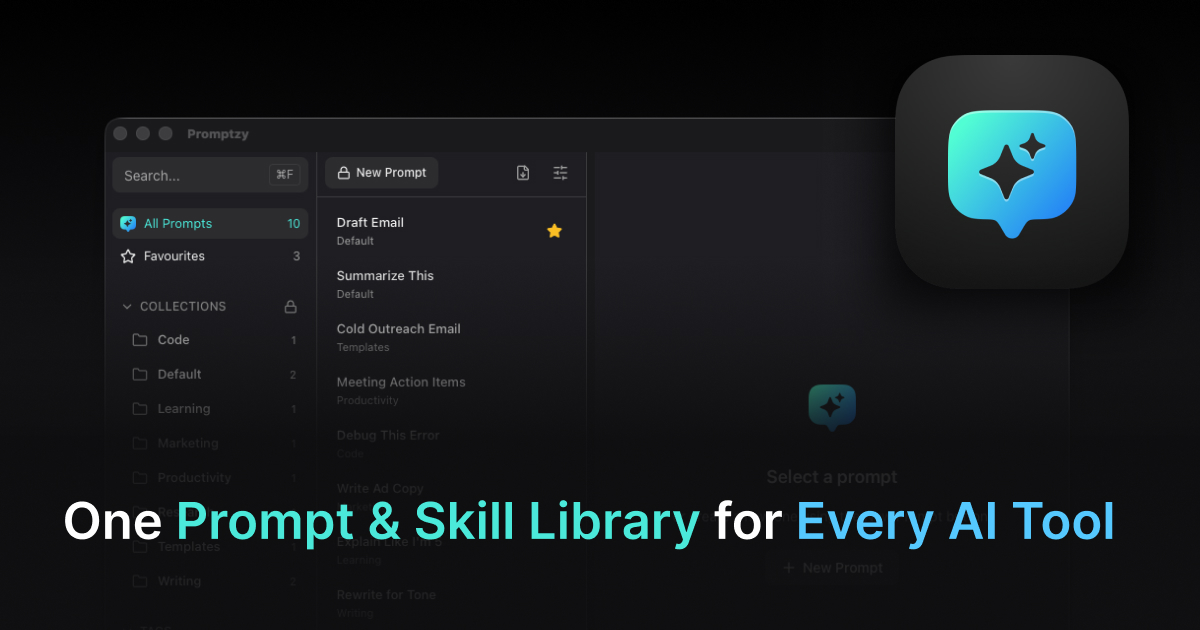
If you're running the same research prompts repeatedly — market monitoring, competitor tracking, weekly digests — storing them somewhere accessible saves setup time. You can organize your research prompts on Mac to keep your best Perplexity templates one shortcut away. Promptzy stores these as plain Markdown files and pastes any prompt into any app in under 2 seconds. A "Research" collection means your best Perplexity prompts are one Cmd+Shift+P away.
Store and manage your prompts with Promptzy
Free prompt manager for Mac. Search with Cmd+Shift+P, auto-paste into any AI app.
Download Free for macOS