
Claude + Cursor: How to Keep Your Skills in Sync Automatically
Keeping skills in sync between Claude and Cursor requires a bridge that reads and writes both Claude's project instructions and Cursor's .cursorrules files, with conflict detection when the same skill diverges. Promptzy provides this bridge, syncing skills bidirectionally between both tools so edits in one automatically appear in the other.
If you use both Claude and Cursor, you already know the friction. Claude is your thinking partner for architecture, research, and complex problem-solving. Cursor is where you write and refactor code. Both benefit from the same underlying skills: your coding standards, review processes, documentation style, error handling preferences. But each tool stores these instructions in its own format, in its own silo, with no awareness of the other.
The result is predictable. You maintain two copies of every skill. They start identical. Within a week, they've diverged because you improved one version in Claude during a late-night debugging session and forgot to update Cursor. Or you refined the Cursor version while pair-programming and never synced it back.
How Claude and Cursor Store Skills Differently
Understanding the formats helps explain why manual sync is fragile.
Claude's Approach
Claude stores skills as project instructions within Projects. Each project has a set of custom instructions that persist across all conversations in that project. You edit them through Claude's web interface.
The format is freeform text or Markdown. There's no file on your disk. The instructions live in Claude's cloud, tied to your account and the specific project.
# Project Instructions (in Claude)

## Code Standards
- Use TypeScript strict mode for all new files
- Prefer functional components with hooks
- Error handling: use typed error classes, never throw strings
- All exported functions need explicit return types

## Review Process
When I share code for review, check:
1. Type safety and null handling
2. Error boundaries and edge cases
3. Performance implications
4. Naming clarity
Cursor's Approach
Cursor stores skills as rules in .cursorrules files at the root of your project directory, or in workspace settings. These are actual files on your filesystem.
# .cursorrules

You are an expert TypeScript developer working on a Next.js application.

## Coding Standards
- Use TypeScript strict mode for all new files
- Prefer functional components with hooks
- Error handling: use typed error classes, never throw strings
- All exported functions need explicit return types

## When Reviewing Code
Check for:
1. Type safety and null handling
2. Error boundaries and edge cases
3. Performance implications
4. Naming clarity
Notice the content is essentially the same, but the format, location, and access method are completely different. Claude's lives in the cloud and is edited through a web UI. Cursor's lives on disk and is edited as a text file. Keeping them aligned manually means remembering to update both whenever either changes.
Why Manual Sync Always Fails
People try various manual approaches. All of them break down.
The Clipboard Approach
You update a skill in Claude, copy it, open your .cursorrules file, find the matching section, replace it. This works for the first week. Then you forget once, and the versions diverge. You don't realize they've diverged until you notice different behavior between tools, which might take days.
The Shared Document Approach
You keep a "canonical" version in Notion, Google Docs, or Apple Notes. When you update a skill, you update the document first, then copy to both tools. This adds a third location to maintain. It also means you can never edit directly in Claude or Cursor without going through the document first, which breaks natural workflow.
The Git Approach
You version-control your .cursorrules files (smart) and try to use the same repo as your reference for Claude's instructions. This handles the Cursor side well but doesn't solve Claude's side. There's no mechanism for Git to push changes into Claude's project instructions, or for Claude edits to flow back to Git.
Each approach requires discipline that doesn't survive real working conditions. The moment you're focused on solving a problem, updating skills in three places is the last thing on your mind. You want to read more about the broader silo problem and how to solve it, see our guide to syncing skills across all AI tools.
Automatic Sync with Promptzy
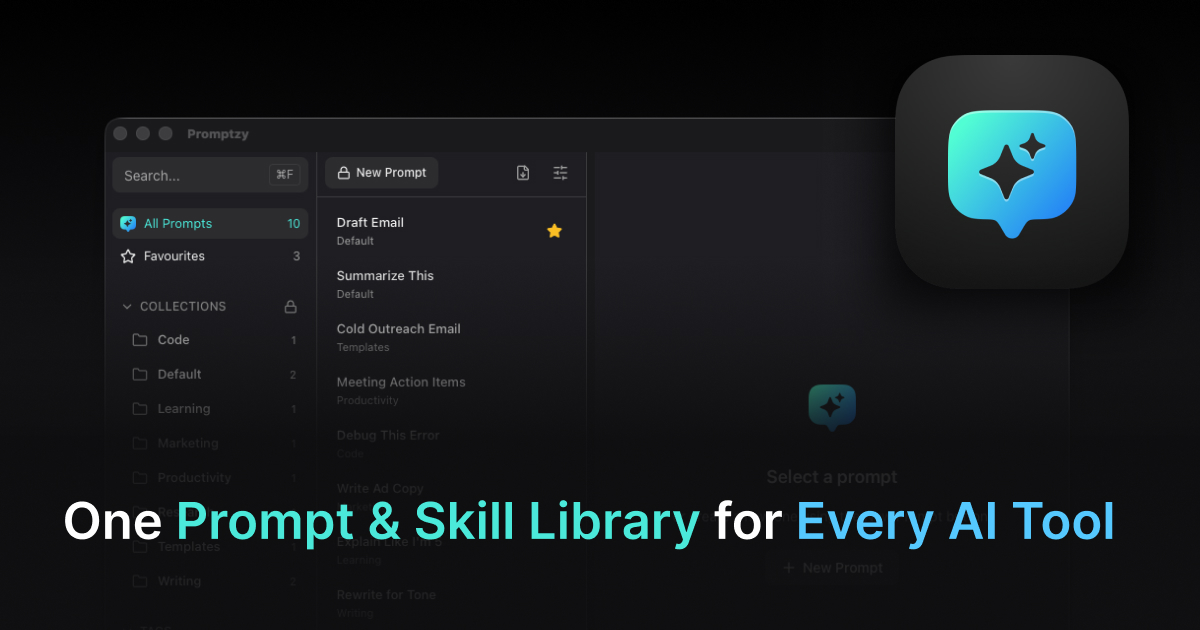
Promptzy sits between Claude and Cursor as a sync layer. Here's how it works in practice.
The Setup
- Install Promptzy and create your skill library (or import existing skills from Claude and Cursor)
- Connect Claude: Link your Claude Projects so Promptzy can read and write project instructions
- Connect Cursor: Point Promptzy to your project directories where
.cursorrulesfiles live - Map skills: Decide which skills should sync to which tools
The initial setup takes about 10 minutes. After that, sync is automatic.
The Sync Flow
Once connected, the sync works in three directions:
Promptzy to Claude and Cursor: Edit a skill in Promptzy's Markdown editor and the change propagates to both tools automatically.
Claude to Promptzy and Cursor: Edit a skill in Claude's project instructions and Promptzy detects the change, updates its central library, and pushes the update to your .cursorrules file.
Cursor to Promptzy and Claude: Edit your .cursorrules file (directly or through Cursor's settings) and Promptzy detects the filesystem change, updates the central library, and pushes the update to Claude.
You work wherever is natural. The sync happens in the background.
Conflict Resolution
The inevitable scenario: you edit the same skill in both Claude and Cursor before sync runs. Promptzy detects the conflict and presents both versions, letting you choose which one wins (or merge them manually). The winning version then propagates everywhere.
This is the critical piece that no manual approach handles well. Without explicit conflict resolution, one version silently overwrites the other and edits get lost.
Real Workflows: Claude + Cursor in Practice
Here's how synced skills change daily work across both tools.
Workflow 1: Architecture in Claude, Implementation in Cursor
You're building a new feature. The process:
- Claude: Discuss architecture with Claude using your "System Design" skill, which defines how you think about components, data flow, and API contracts
- Claude: Refine the approach, with Claude following your architectural preferences consistently
- Cursor: Switch to Cursor to implement. The same system design skill is already in
.cursorrules, so Cursor's suggestions align with the architecture you just designed in Claude - Cursor: While implementing, you realize the skill should mention "prefer composition over inheritance for React components." You update
.cursorrules - Sync: The update flows back to Claude. Next architecture discussion already includes the new preference
Without sync, step 3 produces suggestions that might contradict the architecture from step 2, because Cursor is working from a different (possibly outdated) set of instructions.
Workflow 2: Code Review Across Both Tools
Your code review skill defines severity levels, what to check, and how to format feedback. You use it in both tools:
- Cursor: For inline review as you write code, catching issues before you commit
- Claude: For thorough PR reviews where you paste larger diffs for analysis
Both tools need the same review criteria. If you tighten the security review section in Claude (adding "check for API key exposure in environment variables"), that improvement should immediately apply to Cursor's inline reviews too.
Workflow 3: Documentation Standards
You have a documentation skill that defines how to write README files, API docs, and inline comments:
## Documentation Standards

README structure:
1. One-sentence description of what this does
2. Quick start (copy-pasteable commands to get running)
3. Configuration options (table format)
4. Architecture overview (for repos with 5+ files)

Inline comments: explain WHY, not WHAT
API docs: include request/response examples for every endpoint
This skill matters in Cursor (where you generate docs while coding) and in Claude (where you ask for documentation reviews or generate docs for existing code). Keeping them aligned means consistent documentation regardless of which tool produced it.
Workflow 4: Debugging Across Tools
Your debugging skill defines a structured approach:
## Debugging Process

When I describe a bug:
1. Restate the expected vs actual behavior
2. Identify the most likely root cause
3. Suggest the minimum reproduction case
4. Propose a fix with explanation
5. Identify what tests would prevent regression

Do not jump to solutions. Diagnose first.
In Claude, you paste error logs and stack traces for analysis. In Cursor, the same skill guides Cursor's inline suggestions when you're working through a bug. Same process, same quality, zero manual copying.
What You Gain Over Time
The compounding effect of synced skills between Claude and Cursor is significant.
Month 1: You migrate your existing skills from both tools into Promptzy. Initial setup. The skills start identical in both tools.
Month 2: You've made 15-20 small refinements across both tools during normal work. Without sync, these improvements would be split between Claude and Cursor with no overlap. With sync, every improvement benefits both tools. Your best Claude skills and best Cursor skills are the same skills.
Month 3: Your skill library has genuinely improved because every interaction with either tool is an opportunity to refine. You're getting measurably better output from both Claude and Cursor because the accumulated refinements are everywhere.
Month 6: Your skill library is dramatically better than what you started with. The improvement happened naturally, during normal work, without dedicated "skill maintenance" time. Sync made the improvement frictionless.
This compounding effect is the real argument for automatic sync. It's not about saving the 30 seconds of copying. It's about enabling a continuous improvement loop that manual sync can never sustain.
Promptzy vs. Other Approaches for Claude-Cursor Sync
vs. PromptBox
PromptBox is a Chrome extension. It can interact with Claude's web interface but has no concept of .cursorrules files or Cursor's configuration. It's one-directional at best: Chrome to Claude. Cursor is completely out of scope.
vs. TextExpander / Raycast Snippets
Both can paste text into any app, including Claude and Cursor. But pasting is not syncing. They can't write to .cursorrules files, can't update Claude's project instructions, and can't detect when either tool's skills have changed. They're paste tools, not sync engines. For a broader comparison of all the options, see our AI skills manager comparison.
vs. Custom Scripts
Some developers write scripts that copy files between locations. This handles the Cursor side (filesystem) but not the Claude side (API/web-based). It's also one-directional and has no conflict resolution. If you're technical enough to write sync scripts, you're technical enough to appreciate why a purpose-built tool with conflict resolution is worth $5.
vs. Doing Nothing
The default. Maintain separate skill libraries in each tool. This works until it doesn't. The divergence is gradual and invisible until you notice Claude and Cursor giving contradictory advice based on different versions of the same skill. By then, reconciling the differences is harder than it would have been to sync from the start.
Setting Up Promptzy for Claude + Cursor
Here's the step-by-step to get started.
Step 1: Consolidate
Open Claude Projects and copy out every project instruction you want to sync. Open your .cursorrules files and copy those too. Paste each into Promptzy as a skill. Remove duplicates, pick the best version of each skill where they've already diverged.
Step 2: Connect
In Promptzy's sync settings, connect both Claude and Cursor. For Cursor, point to the root directories of your projects. For Claude, authorize access to your Projects.
Step 3: Map
Decide which skills go where. Most development skills should sync to both tools. Some might be Claude-only (like a "research methodology" skill) or Cursor-only (like editor-specific formatting preferences).
Step 4: Set Conflict Resolution
Start with "ask me every time" so you see how conflicts arise in your workflow. After a few weeks, you'll know whether automatic resolution (newest edit wins, or Promptzy always wins) suits your style.
Step 5: Work Normally
This is the important part. Don't change how you work. Edit skills in Claude when you're in Claude. Edit .cursorrules when you're in Cursor. Edit in Promptzy when you want to use the Markdown editor. Sync handles the rest.
Dynamic Variables in Synced Skills
Synced skills become even more powerful with dynamic variables. A skill like:
## Daily Code Review

Today is {{date}}. Review the following code with extra attention to:
- Changes since our last release
- Any TODO comments that reference dates before {{date}}
- Temporary workarounds that should be permanent by now

{{clipboard}}
The {{date}} and {{clipboard}} tokens resolve at paste time when triggered through Promptzy's global shortcut. The skill itself syncs as a template, with the tokens intact, to both Claude and Cursor.
Getting Started
Download Promptzy and consolidate your Claude and Cursor skills into one library. The free tier supports 10 skills. Pro is a one-time $5 for unlimited skills, multi-directional sync, {{clipboard}} tokens, per-skill keyboard shortcuts, and iCloud Sync across Macs.
If Claude and Cursor are your primary AI tools, syncing skills between them is one of the most impactful workflow improvements you can make. Every skill refinement in either tool becomes a permanent, cross-tool upgrade. For guidance on resolving skill conflicts when sync detects divergences, see our dedicated guide.
Store and manage your prompts with Promptzy
Free prompt manager for Mac. Search with Cmd+Shift+P, auto-paste into any AI app.
Download Free for macOS