
The Best GitHub Copilot Prompts for Faster Coding (2026)
GitHub Copilot has evolved well past autocomplete. With Copilot Chat, workspace agents, and slash commands, it's now a full coding assistant — but most developers are still using it for simple completions and occasionally asking it to explain something. The prompts below are written for the full Copilot experience: inline suggestions, Chat, and the workspace agent.
These are specific, tested, and honest about what Copilot does well versus where you'll get better results from a standalone model like Claude or ChatGPT. If you find yourself reaching for the same patterns repeatedly, you can save Copilot prompt patterns you use repeatedly so they're always one shortcut away.
Code Review
Copilot Chat is surprisingly good at code review when you give it focused prompts. These get more useful output than generic "review this code" requests. For a deeper dive into review-specific patterns across tools, see our AI prompts for code review guide.
1. General code review
/review

Review this code for: bugs, security issues, performance problems, and readability concerns. Be specific — call out line numbers where possible and suggest concrete fixes.
2. Security-focused review
Review this code specifically for security vulnerabilities. Check for: SQL injection, XSS, insecure deserialization, hardcoded secrets, improper input validation, and any OWASP Top 10 concerns.

{{clipboard}}
3. Performance review
Analyse this code for performance issues. Identify expensive operations, unnecessary iterations, memory leaks, and N+1 query patterns. Suggest specific optimisations.

{{clipboard}}
4. Review for maintainability
Review this code from a maintainability perspective. Is it readable? Is the naming clear? Are there any abstractions missing or over-engineered? How would a new team member experience this?

{{clipboard}}
5. Pull request review checklist
I'm reviewing this pull request diff. Go through it and check for: (1) correctness — does the logic do what it claims, (2) edge cases that aren't handled, (3) test coverage gaps, (4) any naming or style inconsistencies, (5) anything that could break existing behaviour.

{{clipboard}}
Test Generation
Test generation is one of Copilot's strongest use cases when you're specific about what you want.
6. Write unit tests for a function
Write comprehensive unit tests for this function. Cover: happy path, edge cases, error cases, and boundary conditions. Use the testing framework already in this project.

{{clipboard}}
7. Write tests for untested code
This code has no tests. Write unit tests that give good coverage. Identify any parts that are hard to test and suggest how to refactor them for testability.

{{clipboard}}
8. Write integration tests
Write integration tests for this feature. Focus on the interactions between components, not just individual functions. Mock external dependencies appropriately.

{{clipboard}}
9. Identify test gaps
I have this code and these existing tests. Identify what's not covered by the tests and write additional tests to fill the gaps.

Code: {{clipboard}}
10. Write a test for a specific bug
Write a regression test that would have caught this bug before it was introduced: [describe the bug]. The test should fail on the buggy code and pass on the fix.
Documentation
11. Write function documentation
Write clear, accurate documentation for this function. Include: what it does, parameters with types and descriptions, return value, exceptions it can throw, and a usage example.

{{clipboard}}
12. Write a README section
Write a clear README section for this module or feature. Cover: what it does, how to use it, required configuration, and a code example.

{{clipboard}}
13. Write inline comments for complex logic
Add inline comments to this code that explain the "why" behind non-obvious decisions. Don't comment obvious things — focus on logic that would confuse a new developer.

{{clipboard}}
14. Generate API documentation
Generate API documentation for this endpoint or function. Use a clear format covering: purpose, request parameters, response format, error codes, and an example request/response.

{{clipboard}}
Debugging
15. Explain an error
I'm getting this error: {{clipboard}}

Explain what's causing it, what part of the code is responsible, and give me a fix.
16. Trace unexpected behaviour
This code should do [expected], but it's doing [actual] instead. Walk me through what's actually happening step by step and explain why it behaves this way.

{{clipboard}}
17. Suggest fixes for a failing test
This test is failing. Here's the test and the error output. Tell me whether the bug is in the implementation or the test itself, and give me a fix either way.

{{clipboard}}
18. Diagnose a performance problem
This function is running slower than expected. Profile it mentally — where are the bottlenecks? What would you change first?

{{clipboard}}
Refactoring
19. Refactor for readability
Refactor this code to improve readability without changing behaviour. Extract functions if needed, improve naming, and remove any unnecessary complexity.

{{clipboard}}
20. Reduce duplication
This codebase has duplication across these files. Identify the patterns and suggest how to refactor them into shared abstractions.

{{clipboard}}
21. Modernise old code
This code was written for an older version of [language/framework]. Update it to use current best practices and modern syntax while preserving all existing behaviour.

{{clipboard}}
22. Break up a large function
This function is doing too much. Break it up into smaller, focused functions. Each function should do one thing and be testable in isolation.

{{clipboard}}
PR Summaries and Commit Messages
23. Write a PR description
Write a clear PR description for these changes. Cover: what problem this solves, how it was approached, what was changed, how to test it, and any edge cases or risks.

Diff summary: {{clipboard}}
24. Write a commit message
Write a clear, conventional commit message for these changes. Format: type(scope): short description. Include a body if the change needs more explanation.

Changes: {{clipboard}}
25. Summarise a PR for review
Summarise this PR for a reviewer who hasn't seen the context. Give them: the problem being solved, the approach taken, what files changed and why, and what to focus on during review.

{{clipboard}}
Workspace Agent Prompts
Copilot's workspace agent (@workspace) has context about your entire project. These prompts work best in that mode.
26. Find all usages of a pattern
@workspace Find all places in the codebase where [pattern/function/class] is used. List them with file paths and explain the context for each.
27. Understand a codebase area
@workspace Explain how [feature/module] works in this codebase. Walk me through the main files involved, how data flows, and what the key abstractions are.
28. Identify all places that need to change
@workspace I need to change [thing]. List all the places in the codebase that will need to be updated, including any tests, config files, and documentation.
29. Find potential breaking changes
@workspace If I change the signature of [function/interface], what else in the codebase would break? List all affected files and usages.
30. Onboard to a new codebase
@workspace I'm new to this codebase. Give me an overview: what does it do, how is it structured, what are the main entry points, and what should I read first to get oriented?
Getting the Most Out of Copilot Chat
A few patterns that improve results:
Use /fix, /explain, /tests slash commands for quick single-purpose requests. They're faster than typing a full prompt and Copilot handles the framing.
Give Copilot the right context. Copilot Chat sees the open file, but if you're asking about interactions between files, paste the relevant code or use @workspace. For chat-based AI work outside the editor, our ChatGPT prompts for developers and Cursor AI prompts guides cover complementary workflows.
Be specific about what you don't want. "Refactor this without changing the public API" or "write tests without mocking the database" saves you from unhelpful suggestions.
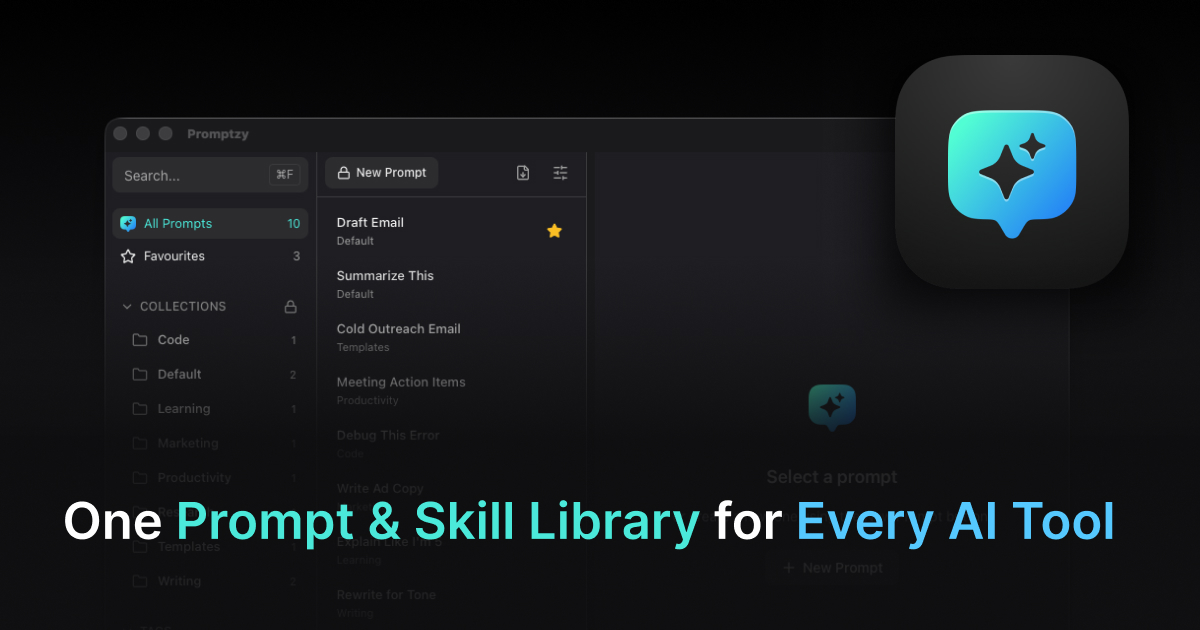
If you're building up a library of prompts across Copilot, Claude, and ChatGPT, you need a way to manage your developer prompts across tools. A prompt manager keeps them together and accessible from anywhere. Promptzy stores prompts as Markdown files and pastes any of them into VS Code, the browser, or anywhere else in under 2 seconds. A "Copilot" collection means your best prompts are one shortcut away — without switching context.
Store and manage your prompts with Promptzy
Free prompt manager for Mac. Search with Cmd+Shift+P, auto-paste into any AI app.
Download Free for macOS